Hot Flames Fire Cup Wrap
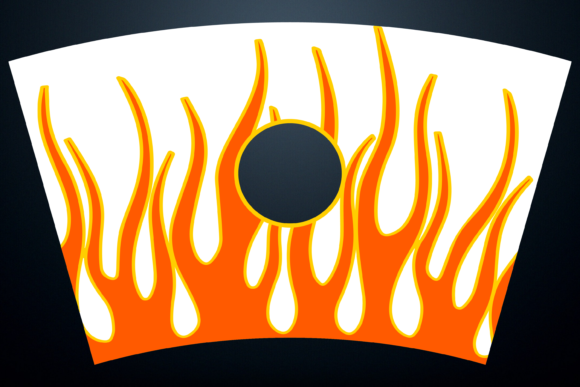
Let’s be real: fire motifs in embroidery walk a fine line between bold and busy, cool and cliché. When I opened Hot Flames Fire Cup Wrap for the first time—prepping it for a custom embroidered tote bag destined for a local coffee shop pop-up—I paused. Not because it was confusing or low-res, but because it *felt* intentional. The flames wrap cleanly around a vertical axis, tapering at top and bottom like heat rising from a real cup. It’s not cartoonish. It’s not overly detailed. And that’s exactly why it works.
A Design That Breathes on Fabric
This isn’t a dense fill-stitch jungle—it’s a smart balance of satin stitch curves and subtle negative space. As a machine embroidery design, Hot Flames Fire Cup Wrap avoids tiny interior corners that snag thread or collapse on thin cotton. I tested it on a medium-weight canvas tote and a brushed poly-blend sweatshirt. On both, the flame shapes held clarity without excessive stitch density—no puckering, no thread nesting. That’s rare in fire-themed graphics, where designers often overcompensate with layers of shading or texture. Here, the simplicity becomes strength: it reads instantly at arm’s length, yet rewards closer inspection with graceful tapering edges and consistent line weight.
Where It Shines (and Where It Doesn’t)
I’ve used Hot Flames Fire Cup Wrap on embroidered patches, baby onesies (yes—scaled down!), aprons for a roastery’s staff, and even as a focal motif on a linen tea towel. It thrives on structured, stable fabrics: twill, denim, midweight knits, and tightly woven cottons. On those surfaces, the design adds energy without overwhelming the item’s function or feel.
But—and this matters—I wouldn’t push it onto stretchy jersey tees or lightweight rayon without significant digitizing tweaks. The vertical flow relies on clean tension control; too much give in the fabric blurs the flame’s upward motion. Likewise, curved surfaces like caps or tumblers? This is a wrap design by name—but as an embroidery file, it’s built for flat or gently contoured planes. Don’t force it onto a baseball cap crown without testing hoop placement and stitch pull on scrap first.
Dark fabric? It sings—especially with high-contrast thread (think orange-red flame on navy or charcoal). Light fabric? Still strong, but test your thread color carefully. A pale yellow or cream flame can read as “smoke” instead of fire unless you boost saturation or add a subtle black outline stitch. And yes—I checked: the digital embroidery file handles both scenarios cleanly, assuming proper stabilizer choice (cutaway for knits, tear-away for stable wovens).
Real Use, Real Feedback
Last month, I stitched Hot Flames Fire Cup Wrap onto six matching aprons for a small-batch roaster. Customers kept asking, “Is that *your* logo?” That’s the sign of a design that feels bespoke—not generic clip art. It elevated their brand without shouting. Same with holiday gifts: embroidered on flannel pillow covers for barista friends, it landed as warm, witty, and handmade—not mass-produced. That perception shift matters. When buyers see thoughtful execution—clean satin stitch edges, balanced spacing, confident scale—they trust the maker more. They’re willing to pay for the finished product, not just the fabric.
What This Means for Your Craft Business
If you’re an Etsy seller, small shop owner, or creative entrepreneur building a cohesive line, Hot Flames Fire Cup Wrap fits neatly into themed collections: coffee lover bundles, barista starter kits, or “morning ritual” gift sets. As a Graphics asset, it pairs effortlessly with minimalist typography or monogrammed initials—no visual competition. And because it’s a Print Templates–style digital embroidery file, you can use it across mediums: stitch it, print it as a sticker decal for packaging, or layer it into a printable mockup for your shop listings. That versatility multiplies its ROI.
Designer Notes You’ll Actually Use
- Always test on scrap first—especially if stitching on textured fabric like terry cloth or bouclé. Flame tips can catch or float if stabilizer isn’t matched precisely.
- Check thread color contrast before committing to a full run. What reads as fiery on screen may mute on oatmeal linen or heather grey.
- Review stitch density visually, not just numerically. This design avoids heavy fill areas, but zoom in on the base of the flames—some versions include subtle gradient-like layering that affects stitch count.
- Confirm hoop size compatibility. While it’s scalable, the full-wrap proportion means extreme shrinking risks losing definition in the flame tips.
- Inspect small details in black-and-white mockups. Fire designs often rely on color illusion—verify shape integrity without hue crutches.
- Use proper stabilizer: cutaway for stretchy or unstable fabrics, tear-away for crisp cottons and linens. Skip the mesh—it won’t support the satin stitch flow here.
- Verify licensing before selling finished items. Since this is marketed as a digital embroidery file for Cricut and tumbler wraps, confirm whether commercial use is included—especially if you plan to sell embroidered patches or apparel at craft fairs or online.
Bottom line? Hot Flames Fire Cup Wrap isn’t flashy wallpaper—it’s a considered design asset. It respects the limits of thread and fabric while delivering personality and polish. Whether you’re stitching personalized gifts, building boutique merchandise, or expanding your digital product catalog, it earns its place not because it’s trendy, but because it works—cleanly, confidently, and consistently.